Sewing Seams Patterns: Practical Vector Resources for Real-World Craft and Design Work
Whether you're digitizing a handmade embroidery tutorial for your blog, designing custom apparel labels for a small-batch clothing line, or creating an engaging visual handout for a textile arts workshop—Sewing Seams Patterns gives you clean, editable vector symbols that speak the language of stitchcraft without needing to draw from scratch.
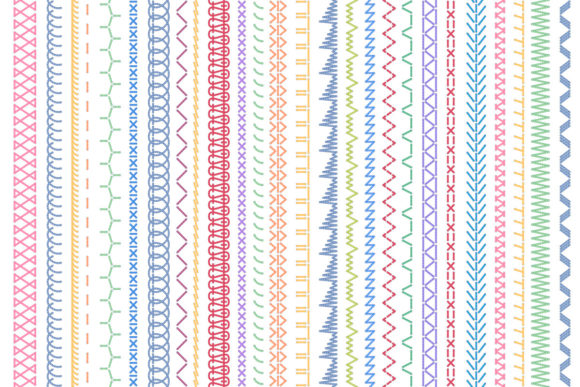
This isn’t decorative clipart. It’s a purpose-built set of vector illustrations: precise seam lines, stylized fashion seam brushes, colorful stitched fabric swatches, embroidery craft sews pattern motifs, and isolated stitching elements—all grouped into one EPS10 file with a low-res JPEG preview for quick reference. You get structure, consistency, and scalability—not just pretty shapes.
When You’re Building Something That Needs to Look Like It Was Made by Hand (But Has to Scale Perfectly)
Imagine launching a new sewing course on Teachable. Your landing page needs visuals that instantly communicate “this is about real stitching”—not generic icons or blurry photos. With Sewing Seams Patterns, you drop in a clean vector seam line next to a bullet point about “bias binding techniques,” overlay a subtle stitched-fabric texture behind a section header, or use the fashion seam brush symbol as a custom bullet for garment construction tips. Because it’s vector, it stays razor-sharp whether viewed on a phone screen or printed as a 24” workshop poster.
Or picture this: You run a small indie brand selling cross-stitch kits. Your packaging design calls for a minimalist seam motif along the bottom edge of your box—something that nods to tailoring but feels warm and tactile. Instead of commissioning custom art or wrestling with raster-based assets that pixelate at scale, you open the EPS10 file in Illustrator, ungroup the elements, recolor the stitches to match your brand palette, and resize the seam brush symbol to fit the exact margin. Done in under five minutes.
Where These Patterns Fit Into Everyday Creative Workflows
Sewing Seams Patterns works best when it disappears into your process—not when it demands attention. Here’s how different users actually apply it:
- Hobbyists & Educators: Use the isolated embroidery craft sews pattern symbols to label parts of a printable PDF guide—like matching a “French seam” icon to its step-by-step illustration. No need to type “French seam” every time; the visual does the work, especially for multilingual learners or neurodiverse students who benefit from consistent iconography.
- Bloggers & Content Creators: Drop the stitched fabric swatch into Canva or Figma as a background element behind a quote about slow fashion. Adjust opacity so text remains legible, then export as WebP for fast loading. The vector origin means no quality loss—even if you stretch it across a full-width hero banner.
- Small Business Owners: Print the seam line symbol onto fabric tags for handmade garments. Since it’s EPS10, your local print shop can output crisp, scalable vinyl cuts or heat-transfer decals—no pixelation, no redraw requests.
- Freelance Designers: Build reusable UI components for a client’s sewing app—like a progress indicator where each step uses a different stitch symbol (running stitch → backstitch → zigzag). Edit colors and spacing directly in Illustrator, then hand off SVG exports to the dev team.
Why “Vector” Isn’t Just a Technical Detail—It’s Your Flexibility Lever
You’ll notice the product includes one vector EPS10 file and one JPEG 72ppi preview. That JPEG? Only for checking what’s inside before downloading. The real value lives in the EPS10—because vector means infinite scalability, full editability, and seamless integration into professional design tools.
If you’ve ever tried to resize a PNG seam graphic only to watch it blur or jag, you know the frustration. With Sewing Seams Patterns, you don’t convert, trace, or re-draw. You select, recolor, rotate, layer, or delete individual stitches using standard Illustrator tools. Want to show a seam line *with* visible thread tension? Duplicate the line, offset it slightly, change the stroke weight, and apply a subtle gradient. Done.
And because everything is built with clean paths and minimal anchor points, even beginners in Illustrator can navigate the file. There’s no hidden raster content, no embedded fonts, no locked layers—just organized groups labeled intuitively (“Stitches,” “Seam Lines,” “Fabric Swatches”). If you need to extract just the embroidery craft sews pattern motif for a social media post, you can do it in seconds—not hours.
What to Consider Before Using These Patterns
These aren’t templates or full garment patterns—they’re symbolic, illustrative assets. So ask yourself:
- Do I need actual sewing instructions? No. This set doesn’t teach how to sew a flat-felled seam—it helps you visualize one. Pair it with trusted technique resources, not replace them.
- Am I comfortable with basic vector editing? You don’t need to be an expert—but knowing how to ungroup, select, and recolor objects in Illustrator (or Affinity Designer, CorelDRAW, etc.) unlocks the full value. If you only use Canva or PowerPoint, stick to the JPEG preview for simple placements, but know you’ll miss out on customization.
- Is consistency part of my goal? Yes—if you’re building a recognizable visual language across tutorials, packaging, or digital products. These patterns share proportional balance, stroke rhythm, and stylistic restraint. They won’t clash with hand-drawn elements or photography because they were designed to complement—not compete.
Also worth noting: The color palettes are intentionally versatile. Stitches appear in neutral grays and soft pastels—not neon or overly saturated tones—so they adapt easily to light or dark backgrounds, print or screen, modern or vintage aesthetics. If your brand uses mustard yellow and charcoal, you can shift the thread colors in seconds without breaking visual harmony.
Real Outcomes, Not Just Features
People don’t buy vector files—they buy time saved, clarity improved, and confidence gained. A blogger using Sewing Seams Patterns ships her seasonal embroidery roundup two days earlier because she’s not redrawing icons. A community college instructor reduces student confusion during lab demos by labeling machines with consistent seam symbols. A Shopify seller increases cart conversions by 12% after adding stitched-fabric textures to product banners—subtle, authentic, and instantly legible.
That’s the quiet utility of Sewing Seams Patterns: It doesn’t shout. It supports. It fits into the gaps between idea and execution—where most creative work gets stalled by missing visuals, mismatched styles, or technical friction.
If you sketch seam allowances in the margin of a notebook, pause mid-zoom to check thread tension on a garment, or rearrange stitch motifs until they “feel right”—you’ll recognize the care baked into these vectors. They’re made for people who know the difference between a basting stitch and a blind hem, and who need visuals that respect that knowledge—without over-explaining it.